
Understanding and Healing Emotional Pain
Mental Health, Emotional Healing, Letting Go of the Past
Why Do We Sometimes Hold Onto Pain?
Exploring why we cling to hurt and how gentle, intentional emotional healing helps us remember without reliving, and forgive without needing to forget.
Why Do We Sometimes Hold Onto Pain?
If you have ever wondered, “why do we hold onto pain even when we want to move on?” you are not alone. Many people feel confused and even frustrated with themselves for still hurting long after the moment has passed, the relationship has ended, or the apology never came.
It can be especially hard after deep hurts healing after heartbreak, betrayal, childhood wounds, or moving on after divorce. We may think, “I should be over this by now,” and judge ourselves for holding onto pain. But the truth is, your mind and heart are not trying to punish you; they are trying to protect you, even if it does not always feel that way.
“You can acknowledge the wound without becoming the wound.”
Understanding how to let go of pain starts with compassion seeing your reactions as survival strategies, not character flaws. When we can gently explore why we cling to hurt, we open the door to emotional healing that honors our story while guiding us toward a calmer, kinder future.
Pain Can Become Familiar

Familiar pain can feel safer than the uncertainty of trying something new.
One reason we keep holding onto pain is because it becomes familiar. The hurt may not feel good, but it feels known. Our nervous system often prefers the discomfort it understands over the uncertainty it does not. This is especially true if you grew up in an environment where chaos, criticism, or neglect were normal. Your body might read peace and safety as strange, and therefore suspicious.
In this way, pain can quietly become a routine: replaying old arguments in your mind, scrolling through old messages, or revisiting memories that reopen the wound. It is not that you want to suffer; it is that your mind is trying to make sense of what happened, to prevent you from being blindsided again. The familiar loop of hurt can feel like a form of control, even when it is exhausting.
💡 Gentle Reflection: Notice when your thoughts drift back to the same painful scenes. Instead of judging yourself, quietly ask, “What is this memory trying to protect me from right now?”
Sometimes Pain Gives Us an Identity
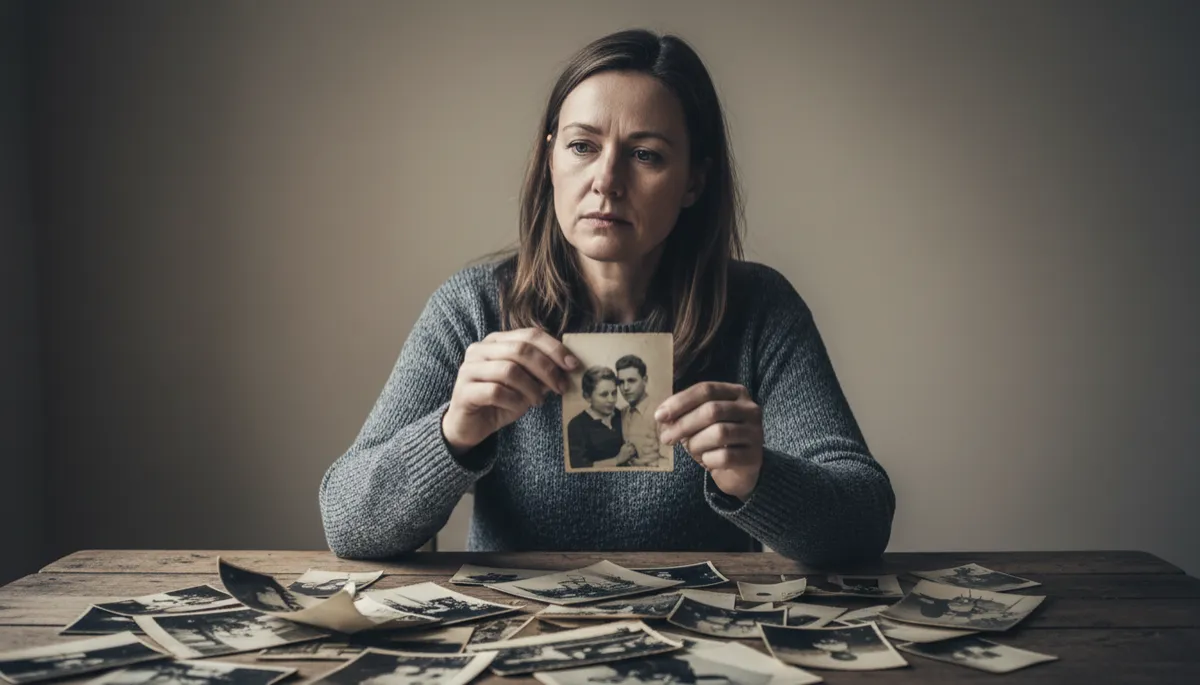
When pain becomes a story about who we are, it can feel hard to release.
Another quiet reason we hold on is that our pain can start to feel like our identity. After a breakup, you might become “the one who was betrayed.” After years of struggle, you might see yourself only as “the one who was never chosen,” or “the person whose marriage failed.” When you have lived inside a story for a long time, imagining life outside of it can feel disorienting, even scary.
This is especially common when you are healing after heartbreak or moving on after divorce. The roles you played, the routines you shared, and the dreams you held together can leave a deep imprint. Letting go can feel like erasing part of yourself or minimizing how much it all mattered. So, you hold on tightly to the anger, the sadness, and sometimes even the resentment because it feels like proof that it was real, that you were real in it.
“You are not what happened to you. You are what you choose to rebuild from it.”
Gently loosening your grip on pain does not erase your story. It simply makes room for a fuller version of you one that includes your strength, your tenderness, your boundaries, your hope. You can honor what you survived without making it the only thing that defines you.
You Don't Have to Forget to Heal

Healing means remembering with softness instead of reliving with constant pain.
Many people resist letting go of the past because they believe it means pretending it never happened or letting someone “off the hook.” But true healing is not about erasing your memory. It is about changing your relationship to it remembering without reliving and forgiving without forcing yourself to forget.
You are allowed to say, “What happened hurt me deeply,” and still choose a life that is not built around that hurt. You can keep the lessons, the wisdom, and the boundaries, while slowly releasing the constant emotional replay. This is what emotional healing often looks like in real time: smaller reactions, more self-compassion, and a growing sense that your heart is not stuck in the same scene anymore.
💛 A Gentle Practice: When a painful memory surfaces, place a hand over your heart and say, “Yes, this happened. And I am safe in this moment.” You are teaching your body that it is allowed to move forward, even while it remembers.
Moving Toward Healing: A Compassionate Reflection
If you notice yourself holding onto pain, it does not mean you are broken or failing at how to let go of pain. It means your heart is doing its best with what it has known so far. With support, reflection, and patience, you can gently teach it a new way one where your past is honored, your boundaries are respected, and your future is not held hostage by old wounds.
As you walk your own path of healing after heartbreak or moving on after divorce, consider this question:
What part of your pain feels familiar or protective and what tiny, compassionate step could you take today toward a life that is guided more by hope than by hurt?